Applications

Erbium-Doped Fiber Amplifier (EDFA) for Optical Amplification

Principles


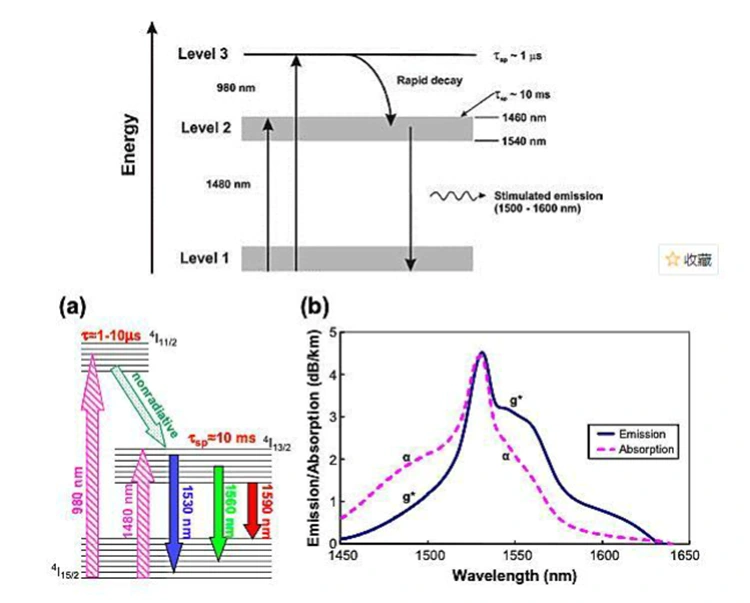
● Energy is injected into the erbium-doped fiber using 980 nm or 1480 nm pump sources, exciting ground-state erbium ions (Er³⁺) to higher energy levels; these ions then rapidly relax to a metastable state, thereby achieving a population inversion.

● When a 1550 nm signal light passes through the erbium-doped fiber, it triggers a stimulated emission process; this causes the metastable erbium ions (Er³⁺) to transition back to the ground state, releasing coherent photons that are identical to the signal light, thereby achieving exponential amplification of the signal power (in the small-signal regime).

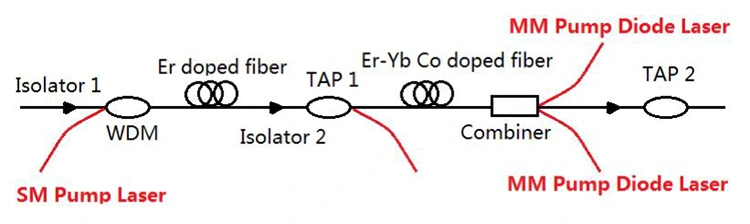
● By employing erbium-ytterbium co-doped fibers combined with multimode pump combining technology, the saturated output power can be significantly enhanced (reaching power levels of several watts), thereby meeting the requirements of ultra-long-distance submarine cables, high-power CATV systems, and high-density transmission scenarios.


Optical Path Structure


Key Component Functions


Component

Description

Optical Isolator

Conducts optical signals in one direction, prevents reflected light from causing self-oscillation, and protects the pump source and signal link stability.

WDM Coupler

Efficiently couples single-mode (SM) 980/1480 nm pump light and 1550 nm signal light into erbium-doped fiber for simultaneous energy and signal transmission.

Er-doped Fiber

The core gain medium that amplifies optical signals through energy level transition of erbium ions, determining the basic gain and noise performance.

TAP Splitter

Taps part of the optical signal in real time for power monitoring without affecting the main link, enabling system status visualization.

Er-Yb Co-doped Fiber

Improves pump absorption efficiency and saturated output power, suitable for high-power and long-haul amplification applications.

Combiner

Couples multi-mode (MM) pump light with pre-amplified signal light to realize high-power pump injection and enhance post-stage gain; widely used in high-power EYDFA designs.

PumpLaserSource

Provides excitation energy at 980 nm / 1480 nm:

• 980 nm pump: low noise, high efficiency, suitable for medium- and short-haul applications

• 1480 nm pump: higher saturation power, suitable for ultra-long-haul and submarine cable applications

• Multi-mode pump: suitable for high-power amplification requirements


Product List (Products We Offer)


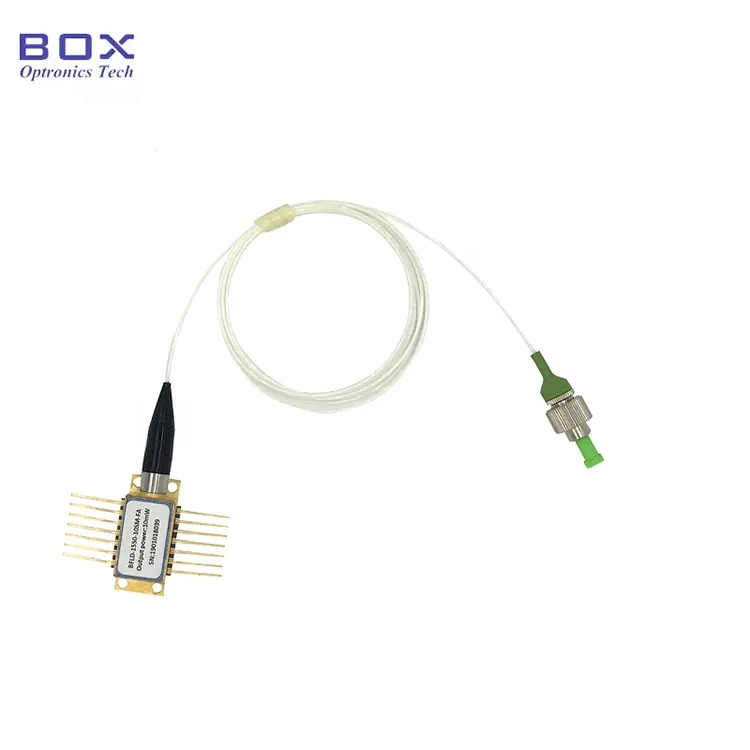
980nm TEC-Cooled Pump Laser Diode

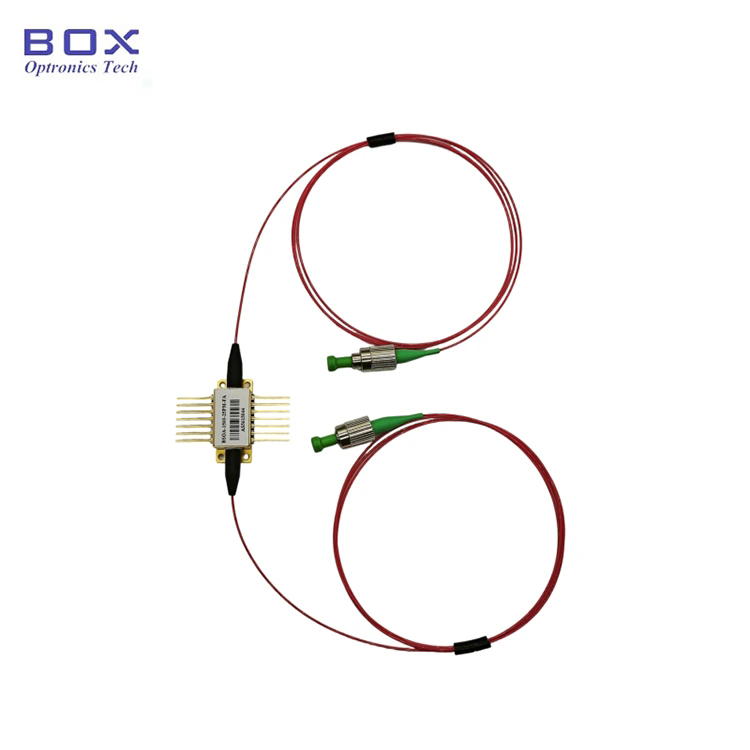
980nm Pump Diode Laser Module with Built-in Drive Circuits

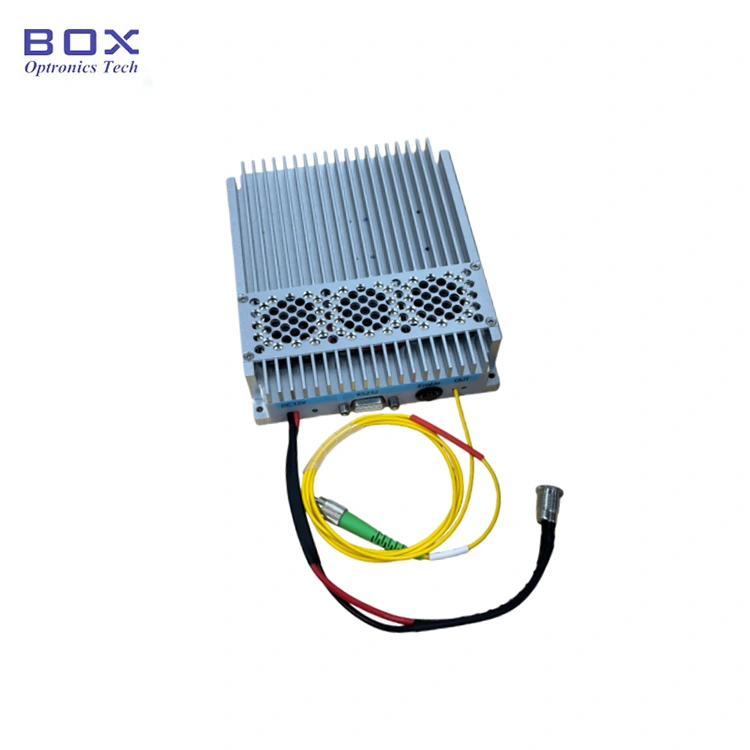
C-band Erbium-doped Fiber Booster Amplifier

1457nm Raman Pump Laser Source


FAQ


Q1: What are the advantages of 980 nm pumping and 1480 nm pumping respectively?

A1: Advantages of 980 nm pumping: high pump conversion efficiency and lower noise figure. It is the mainstream choice for low- to medium-power EDFAs, widely used in metropolitan area networks, access networks, and some data center interconnection scenarios.

Advantages of 1480 nm pumping: higher pump quantum efficiency and higher single-device output power, which significantly improve the saturated output power. It is the core pumping solution for high-power EDFAs, especially suitable for ultra-long-haul backbone networks, submarine optical cables, and high-capacity long-distance transmission scenarios.


Q2: What is the difference between single-mode and multi-mode EDFA?

A2: All mainstream EDFAs in the industry are single-mode EDFAs; there are no commercially viable multi-mode EDFA products. Single-mode EDFAs are designed specifically for single-mode fiber systems, matching the low-loss characteristics of single-mode fiber. They are mainly used for long-distance optical transmission and serve as core components in telecommunications and long-distance data center transmission. Multi-mode fiber is only suitable for short-distance transmission of around 100 meters, with high transmission loss and multipath dispersion. For gain compensation in short-distance scenarios, small semiconductor optical amplifiers (SOAs) are preferred instead of EDFAs.


Q3: Does wavelength range affect EDFA performance?

A3: Yes, wavelength affects EDFA performance. EDFAs mainly operate in the C-band and L-band, centered at approximately 1550 nm. Within the designed range, they provide flat gain and low noise; beyond the range, gain decreases and noise increases. To ensure EDFA performance, please ensure the amplifier’s wavelength range matches system requirements.


X
We use cookies to offer you a better browsing experience, analyze site traffic and personalize content. By using this site, you agree to our use of cookies.Privacy Policy
RejectAccept