Applications

SLED for Optical Coherence Tomography(OCT)

Principles


(1) Light emitted by a broadband, low-coherence source (such as an SLED) is split into two beams by a beam splitter (or fiber coupler), entering the reference arm and the sample arm, respectively.

(2) The light in the reference arm is reflected back by a mirror.

(3) After the light in the sample arm illuminates the tissue or material under investigation, backscattered light from various depths returns.

(4) The two beams recombine at the beam splitter; an interference signal is generated only when the optical path difference between the two arms falls within the coherence length of the light source. This short coherence length ensures the system's high axial resolution.

(5) By scanning the position of the reference mirror or employing frequency sweeping to acquire interference signals, the system can reconstruct two-dimensional or three-dimensional tomographic images of the sample layer by layer.


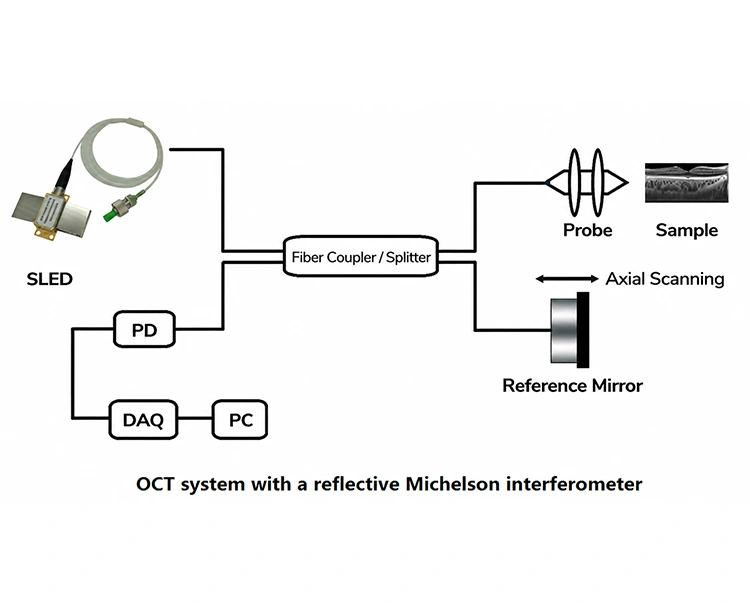
Optical Path Structure


Key Component Functions


Component

Function Description

SLED Light Source

Provides broadband low-coherence light, serving as the core light source for the OCT system to achieve high axial resolution; typically operates in the near-infrared band of 800–1550 nm.

Fiber Coupler / Splitter

Splits the light source into a sample arm and a reference arm, and combines the echo signals from both arms into the detector.

Probe

Focuses the light beam onto the surface or interior of the sample, and collects back-reflected / back-scattered optical signals from different depths.

Reference Mirror

Provides a stable reference optical path. It changes the optical path length of the reference arm through precise axial scanning, realizes interference signal matching with reflected light from different sample depths, and completes depth-resolved scanning.

PD

Detects interference optical signals from the sample arm and reference arm.

Data Acquisition System

(DAQ)

Converts photoelectric signals into digital signals for real-time processing and storage by the computer.

PC

Processes the acquired interference signals via algorithms such as Fast Fourier Transform (FFT), and reconstructs high-resolution 2D or 3D tomographic images of the sample.


Product List (Products We Offer)


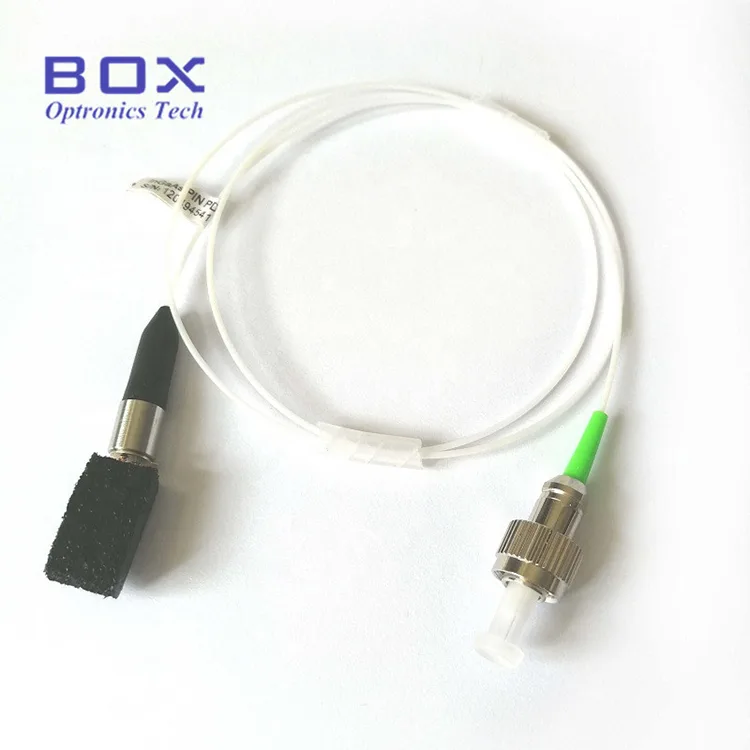
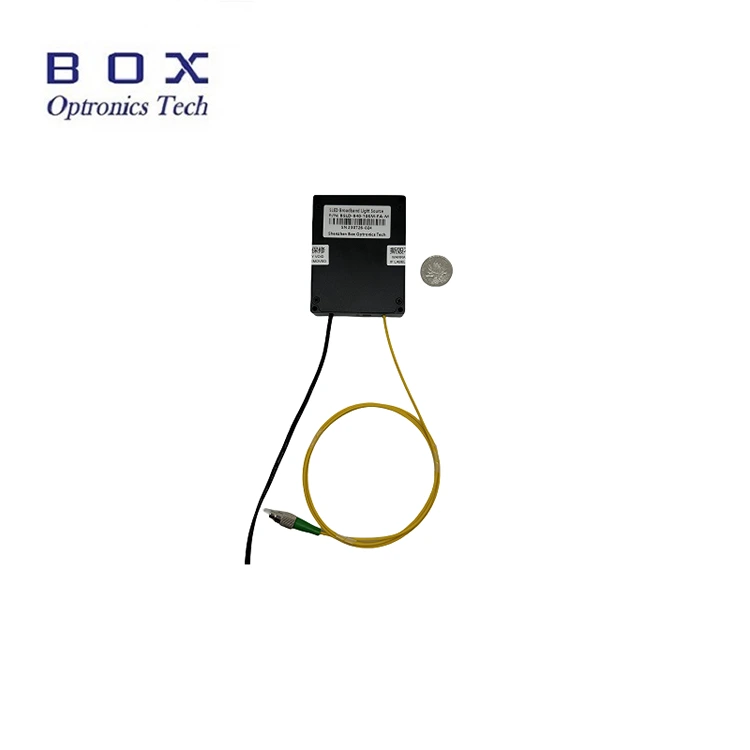
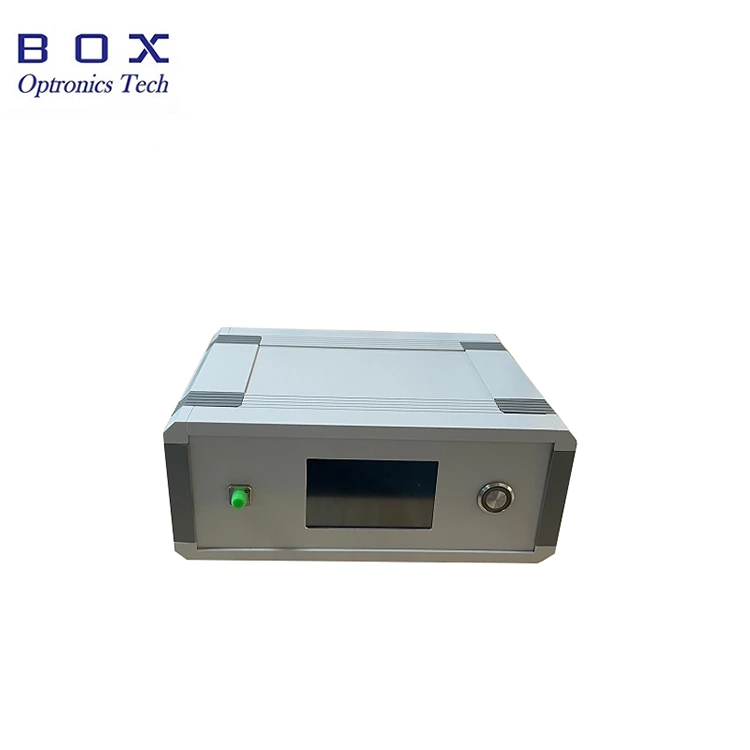
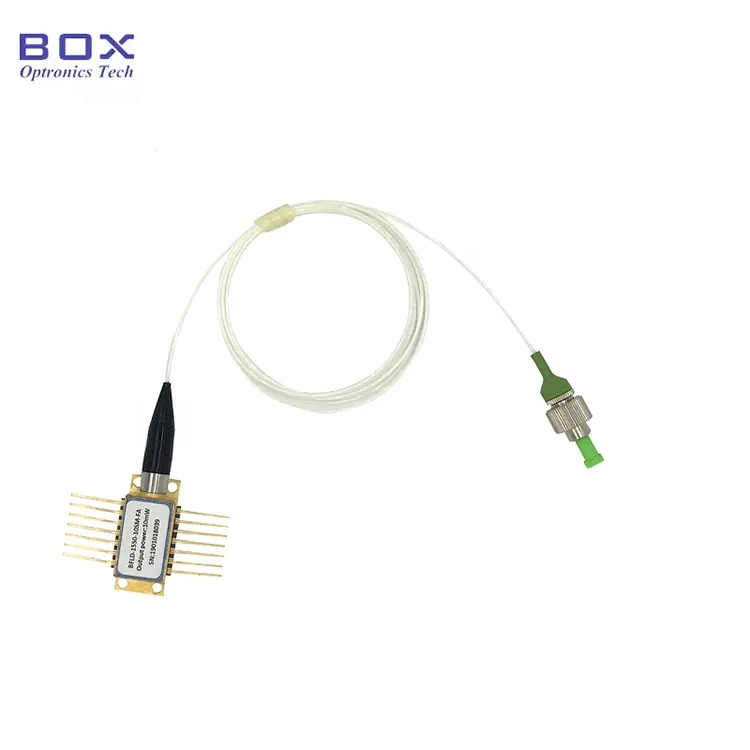
840nm 20mW SLED Broadband Light Source

840nm 10mW 35nm BW SLD Diode

1060nm 1064nm SLD Light Source


FAQ


Q1: What wavelength (in nm) of SLD broadband light source is typically used in OCT?

A1: Biomedical Imaging → 800–1060nm;

Industrial Inspection/Fiber Optics Applications → 1300–1550nm.


Q2: Does a SLED broadband light source require an isolator?

A2: For industrial applications, it is necessary to independently assess the magnitude of the reflected optical power; if warranted, multiple isolators may be required.


Q3: Do the SLD light sources you provide come with a built-in driver circuit?

A3: Yes, we offer modular solutions that integrate the laser chip, driver circuit, and (optionally) a fiber coupler. This allows for direct use or further system integration without the need for the customer to connect an external driver.


X
We use cookies to offer you a better browsing experience, analyze site traffic and personalize content. By using this site, you agree to our use of cookies.Privacy Policy
RejectAccept