News

How Does an Erbium-Doped Fiber Amplifier Improve Optical Communication Performance?

2026-08-05 0 Leave me a message

Article Summary:

As global data traffic continues to grow, optical communication networks require higher transmission capacity, longer distances, and more reliable signal performance. An Erbium-Doped Fiber Amplifier (EDFA) has become one of the most important technologies for solving signal attenuation problems in fiber optic systems. By amplifying optical signals directly without converting them into electrical signals, EDFAs help communication networks achieve efficient long-distance transmission with improved stability and reduced complexity.

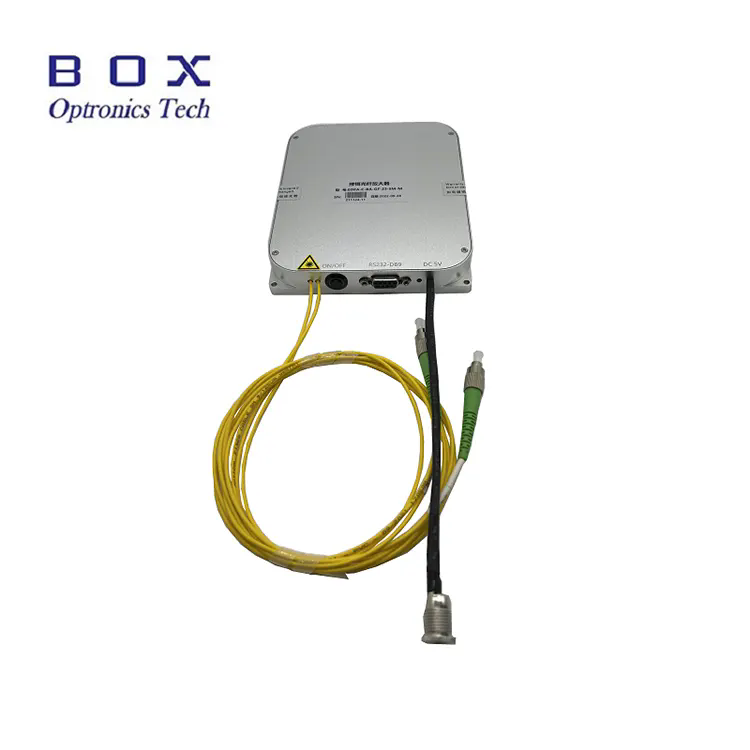
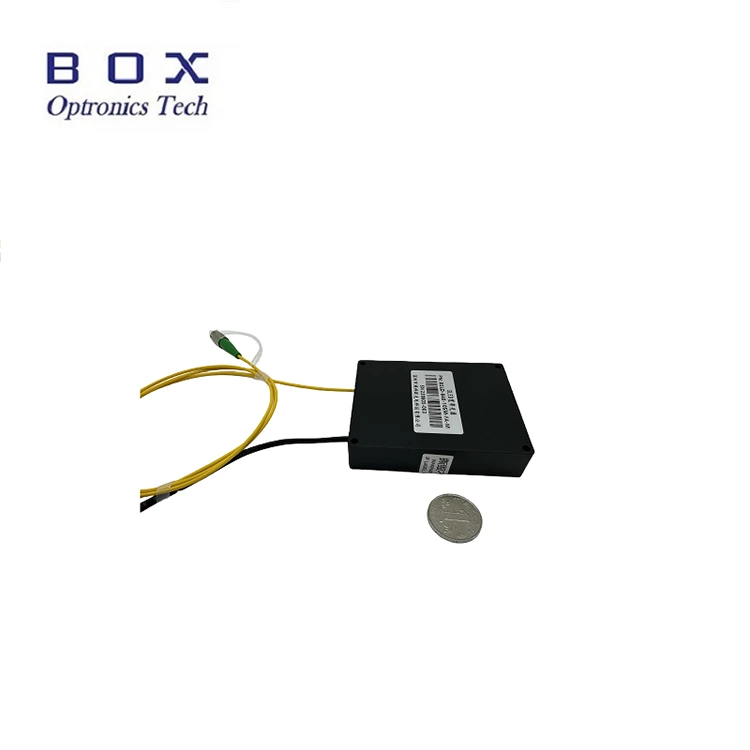
C-band Erbium-doped Fiber Pre-Amplifier

This article explains how an Erbium-Doped Fiber Amplifier works, why it is essential for modern optical networks, what challenges it solves, and how businesses can choose the right amplification solution. Based on professional optical technology experience from Box Optronics, this guide provides practical insights for engineers, system integrators, and communication equipment buyers.


Table of Contents


1. What Is an Erbium-Doped Fiber Amplifier?

An Erbium-Doped Fiber Amplifier, commonly known as EDFA, is an optical amplifier that uses erbium-doped optical fiber as the gain medium to strengthen optical signals. Unlike traditional electronic repeaters that require optical-electrical-optical conversion, an EDFA directly amplifies light signals while they remain in the optical domain.

This technology operates mainly in the C-band and L-band wavelength ranges, which are widely used in modern fiber communication systems. Because of its high gain, low noise characteristics, and ability to support wavelength division multiplexing (WDM), EDFA has become a key component in backbone networks, data centers, and long-distance optical transmission systems.

For communication equipment manufacturers and network operators, maintaining signal quality over long transmission distances is one of the biggest challenges. Fiber loss, connector loss, and environmental interference can gradually weaken optical signals. An Erbium-Doped Fiber Amplifier provides an effective solution by restoring signal strength before data quality is affected.


2. How Does an Erbium-Doped Fiber Amplifier Work?

The operating principle of an EDFA is based on stimulated emission. The amplifier contains a section of optical fiber doped with erbium ions. When pump light from a laser source enters the doped fiber, erbium ions become energized and reach an excited state.

When a weak optical signal passes through the erbium-doped fiber, the excited erbium ions release stored energy in the form of additional photons. These newly generated photons have the same wavelength, phase, and direction as the original signal, resulting in an amplified optical output.

The main components of an Erbium-Doped Fiber Amplifier usually include:

  • Pump Laser Source: Provides energy to excite erbium ions.
  • Erbium-Doped Fiber: Acts as the amplification medium.
  • Optical Isolator: Prevents unwanted signal reflection.
  • Optical Coupler: Combines pump light and input optical signals.
  • Control Circuit: Monitors and manages amplifier performance.

Through the cooperation of these components, EDFA technology can significantly increase transmission distance while maintaining excellent signal integrity.


3. Why Is EDFA Important for Optical Communication Systems?

Modern communication networks face increasing pressure from video streaming, cloud computing, artificial intelligence applications, and large-scale data exchange. As bandwidth demand increases, optical transmission systems must handle higher capacity while maintaining reliability.

One major problem in optical communication is attenuation. When light travels through optical fiber, its power gradually decreases because of absorption, scattering, and other physical effects. Without compensation, weak signals may cause data errors and communication failures.

An Erbium-Doped Fiber Amplifier addresses this issue by boosting optical power at different points along the transmission path. This allows network operators to build longer links with fewer regeneration points, reducing system complexity and maintenance costs.

Compared with traditional amplification methods, EDFA provides several important benefits:

  • Direct optical signal amplification without electrical conversion.
  • Support for multiple wavelength channels simultaneously.
  • Stable operation over long-distance transmission networks.
  • Lower maintenance requirements compared with electronic regeneration systems.
  • Improved network scalability for future upgrades.

4. Key Advantages of Using an Erbium-Doped Fiber Amplifier

Choosing the right amplification technology directly influences network performance. EDFA has become a preferred choice because it offers a combination of efficiency, reliability, and flexibility.

  • High Optical Gain:
    EDFAs can provide strong signal amplification, helping optical systems overcome transmission losses effectively.
  • Low Noise Performance:
    A low noise figure helps maintain signal quality and reduces the impact of amplifier-generated noise.
  • Wide Operating Bandwidth:
    EDFA technology supports multiple optical channels, making it suitable for dense wavelength division multiplexing systems.
  • High Reliability:
    With fewer optical-electrical conversion processes, the system structure becomes simpler and more stable.
  • Energy Efficiency:
    Direct optical amplification reduces unnecessary signal processing steps and improves overall efficiency.

5. Main Applications of Erbium-Doped Fiber Amplifiers

Erbium-Doped Fiber Amplifiers are widely used in industries where stable and high-capacity optical transmission is required. Their flexibility makes them suitable for different communication environments.

  • Telecommunication Networks:
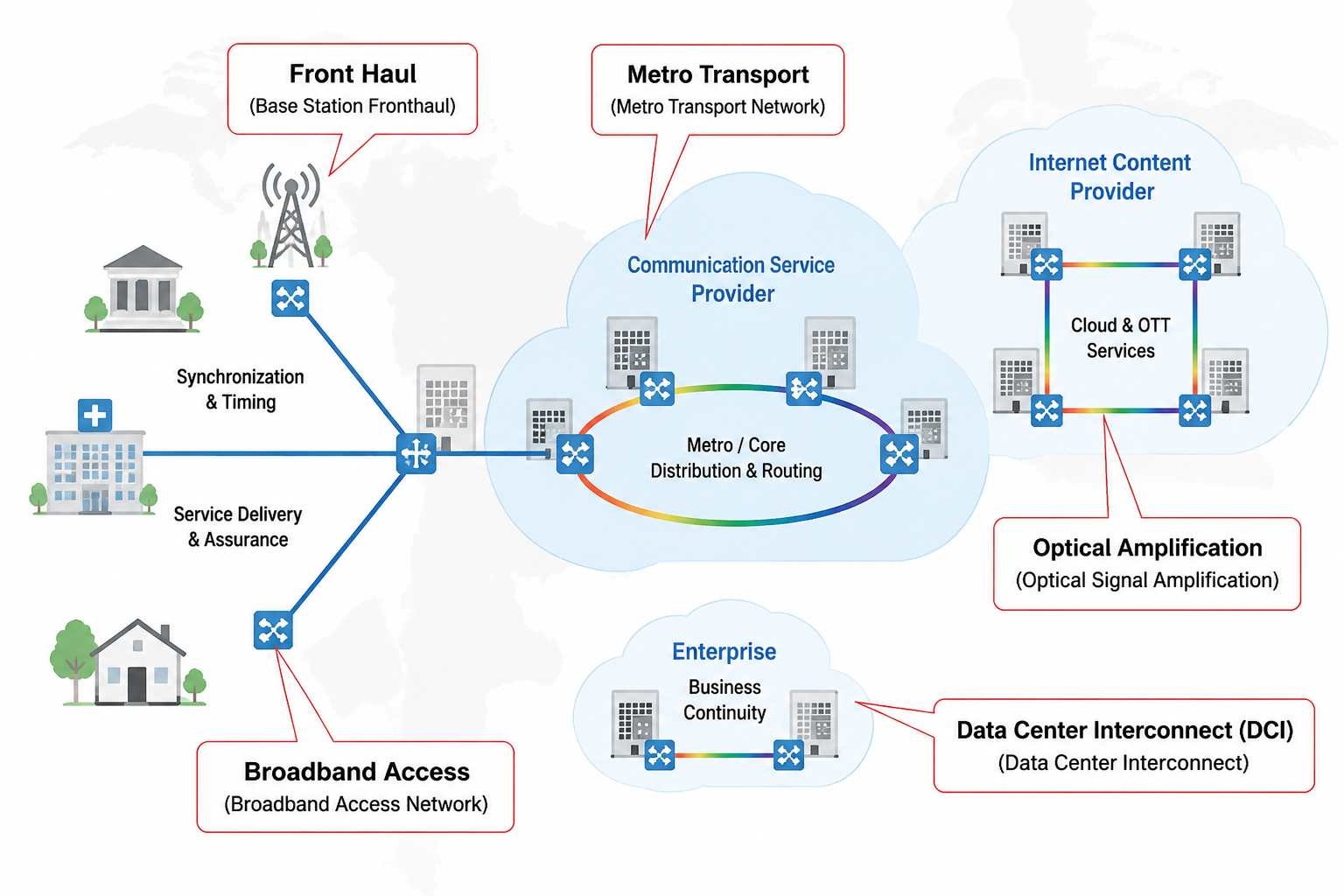
    EDFA is widely deployed in backbone networks and metropolitan optical networks to extend transmission distances.
  • Data Center Interconnection:
    Large data centers require high-speed connections between facilities. EDFA helps maintain optical signal strength across these links.
  • Cable Television Systems:
    Optical amplifiers improve signal distribution quality in fiber-based broadcasting networks.
  • Fiber Laser Systems:
    EDFAs can provide optical gain for specific laser applications requiring stable output power.
  • Research and Testing Equipment:
    Laboratories use optical amplifiers for advanced communication experiments and photonics research.

6. How to Choose the Right EDFA Solution?

Selecting an appropriate Erbium-Doped Fiber Amplifier requires careful consideration of system requirements. Different applications may require different output power levels, gain characteristics, and packaging designs.

Important factors include:

  • Operating Wavelength: Confirm compatibility with the existing optical network.
  • Output Power: Select suitable power levels according to transmission distance.
  • Gain Requirements: Ensure sufficient amplification capability for the application.
  • Noise Figure: Lower noise performance helps preserve signal quality.
  • Environmental Conditions: Consider temperature range and installation requirements.

Professional manufacturers such as Box Optronics provide customized optical amplifier solutions according to different communication scenarios, helping customers achieve reliable and optimized system performance.


7. Common Challenges and Solutions in EDFA Applications

Although Erbium-Doped Fiber Amplifiers provide significant advantages for optical communication systems, engineers still need to consider several technical challenges during design, installation, and operation. Understanding these issues helps users achieve better system reliability and long-term performance.

The following are some common problems and corresponding solutions:

  • Signal Saturation:
    When the input optical power becomes too high, an EDFA may reach its saturation point and cannot provide additional amplification. Selecting an amplifier with appropriate output power capacity and optimizing input signal levels can prevent performance degradation.
  • Noise Accumulation:
    Optical amplifiers introduce a certain amount of amplified spontaneous emission (ASE) noise. Excessive noise may reduce signal quality in long-distance transmission. Using high-quality EDFA modules with optimized noise performance helps maintain transmission accuracy.
  • Power Stability Requirements:
    Communication networks require consistent optical output power. Variations in pump laser performance or environmental conditions may affect stability. Advanced monitoring and control systems can improve operational reliability.
  • System Compatibility:
    Different optical networks may have different wavelength, power, and interface requirements. Selecting a flexible amplifier design ensures easier integration with existing infrastructure.
  • Thermal Management:
    Continuous operation generates heat inside optical equipment. Proper thermal design and reliable component selection are important for extending service life.

Box Optronics focuses on developing optical amplification solutions that address these practical challenges. By combining advanced photonic technology with strict quality control, the company helps customers build stable and efficient optical communication systems.


8. Future Development Trends of Optical Amplification Technology

The demand for faster communication networks continues to increase due to cloud services, artificial intelligence, industrial automation, and next-generation connectivity. Optical amplification technology will continue evolving to support higher capacity and more complex network environments.

Several important trends are shaping the future development of Erbium-Doped Fiber Amplifiers:

  • Higher Output Power:
    Future optical networks require stronger amplification capabilities to support longer transmission distances and increased data capacity.
  • Smaller and More Integrated Designs:
    Compact optical modules will become increasingly important for space-limited applications such as data centers and advanced communication equipment.
  • Improved Energy Efficiency:
    Reducing power consumption while maintaining high amplification performance will become a key design objective.
  • Intelligent Monitoring Functions:
    Modern optical systems are moving toward automated operation, requiring amplifiers with better diagnostic and control capabilities.
  • Support for Advanced Optical Networks:
    Future networks will require amplifiers that can support higher bandwidth, flexible wavelength management, and complex transmission architectures.

As optical communication technology continues advancing, EDFA remains an essential foundation for building reliable high-speed networks. Continuous improvements in optical components and manufacturing processes will further enhance amplifier performance.


9. Comparison Between EDFA and Traditional Optical Signal Regeneration

Understanding the difference between EDFA technology and traditional regeneration methods helps businesses select the right solution for their communication systems.

Feature Erbium-Doped Fiber Amplifier Traditional Optical Regeneration
Signal Processing Direct optical amplification Optical-electrical-optical conversion
Transmission Efficiency High efficiency for long-distance links Requires more processing equipment
Network Expansion Supports wavelength multiplexing upgrades More complex expansion process
Maintenance Requirements Lower maintenance complexity Higher equipment management requirements
Application Range Backbone networks, WDM systems, data transmission Specific systems requiring signal regeneration

For many modern optical communication applications, EDFA provides a more efficient and scalable approach because it preserves optical signals while increasing transmission capability.


10. Frequently Asked Questions About Erbium-Doped Fiber Amplifiers

Q1: What is the main purpose of an Erbium-Doped Fiber Amplifier?

An Erbium-Doped Fiber Amplifier is designed to increase the power of optical signals in fiber communication systems. It compensates for signal loss during transmission and helps networks achieve longer communication distances.

Q2: Why is EDFA widely used in optical networks?

EDFA is popular because it provides high gain, low noise performance, wide bandwidth support, and direct optical amplification without requiring electrical conversion.

Q3: What wavelength range does an EDFA usually support?

Most EDFAs operate in the C-band and L-band wavelength ranges, which are commonly used in modern fiber optic communication systems.

Q4: Can an EDFA support multiple optical channels?

Yes. One of the major advantages of EDFA technology is its ability to amplify multiple wavelength channels simultaneously, making it suitable for wavelength division multiplexing systems.

Q5: How can users improve EDFA operating reliability?

Reliable operation depends on selecting suitable amplifier specifications, maintaining proper optical power levels, controlling environmental conditions, and choosing products from experienced optical technology suppliers.

Q6: What industries commonly use Erbium-Doped Fiber Amplifiers?

EDFAs are commonly used in telecommunications, data center networks, cable television systems, fiber laser applications, and optical research fields.


Conclusion: Building More Reliable Optical Networks with EDFA Technology

An Erbium-Doped Fiber Amplifier plays a critical role in solving one of the biggest challenges in optical communication: maintaining strong and stable signals over long distances. By amplifying optical signals directly, EDFA technology improves transmission efficiency, reduces system complexity, and supports the continuous growth of high-speed communication networks.

From telecommunications infrastructure to advanced photonic applications, reliable optical amplification technology is essential for future connectivity. Selecting a professional supplier with strong technical capabilities can help companies achieve better system performance and long-term operational stability.

Box Optronics provides advanced Erbium-Doped Fiber Amplifier solutions designed for different optical communication requirements. With professional optical technology expertise and customized product support, Box Optronics helps customers overcome transmission challenges and improve network reliability. If you are looking for a dependable optical amplification solution for your application, please contact us today to discuss your requirements and receive professional support.

Related News
Leave me a message
X
We use cookies to offer you a better browsing experience, analyze site traffic and personalize content. By using this site, you agree to our use of cookies.Privacy Policy
RejectAccept